Evaluating Fei Wang Short Drama Acting Quality and Plot Pacing
Short drama has a notorious problem that viewers can spot within seconds: supporting performers who deliver every line with the emotional range of a wooden robot. In a format where an episode may last only a few minutes, stiff reactions can make an entire scene feel artificial. That makes fei wang short drama an interesting case for viewers who want to know whether the acting, directing, and pacing can actually rise above the usual micro-drama shortcuts.
There is one important caveat before getting into the critique. Publicly indexed databases and short-drama catalogs do not currently provide enough reliable information to establish a complete, verified filmography for a performer identified simply as Fei Wang in a specific short drama. Searches also surface unrelated productions and people with similar names, including Jia-Fei Wang, a cinematographer on The Immeasurable, and Erica Fei Wang, who appears in several Canadian short films.
So this evaluation focuses on the performance qualities viewers should examine rather than inventing credits, character names, episode numbers, or plot details that cannot be independently confirmed. That distinction matters, especially with short dramas, where reposted clips often circulate without consistent metadata.
Fei Wang Short Drama and the Acting Question
The first thing to judge in a micro-drama performance is not whether the actor looks convincing in a still frame. It is whether the performance changes naturally from one emotional beat to the next.
Short-form drama gives actors very little room to hide weak choices. A long television episode can spend several minutes establishing a character’s mood. A short drama may have to communicate anger, suspicion, attraction, or betrayal almost immediately. That creates a difficult performance environment.
A useful acting checklist includes:
- Facial reaction: Does the expression change when new information arrives?
- Eye movement: Does the actor react to another character before speaking?
- Dialogue delivery: Does the voice match the emotional situation?
- Physical behavior: Does the body language support the character’s words?
- Timing: Does the reaction happen at the right moment rather than after an obvious pause?
This is where the distinction between competent acting and merely reciting dialogue becomes obvious.
Micro Drama Actors Need More Than Attractive Close-Ups
The close-up is one of the most common tools in vertical short drama. It can make a performer look immediately compelling, but it also exposes weak facial acting.
Good micro drama actors understand that a close-up does not require a permanently intense expression. Sometimes the strongest reaction is almost invisible: a slight tightening around the eyes, a pause before answering, or a brief change in posture.
That restraint is especially important in romance and revenge stories. If every emotional moment receives the same wide-eyed stare, the performance quickly becomes repetitive.
Dialogue Delivery Should Sound Like Conversation
Dialogue delivery is another useful test.
Short dramas often rely on highly compressed exposition. Characters may need to reveal relationships, conflicts, secrets, and motivations within a handful of lines. The actor therefore has to make exposition sound like something a person would actually say.
A convincing performance should distinguish between:
- Information the character is deliberately hiding.
- Information the character genuinely wants another person to understand.
- Information the audience needs but the character would never naturally explain aloud.
When those three levels sound identical, the scene starts feeling written rather than lived.
Emotional Restraint Can Make a Bigger Scene
A revenge reveal does not automatically become powerful because an actor shouts.
In fact, quiet reactions can sometimes create more tension. A character who receives devastating information and becomes unusually calm can be more interesting than someone immediately screaming. The audience begins wondering what the character will do next.
That is the kind of performance choice worth watching when assessing Fei Wang’s screen presence rather than simply asking whether the actor is expressive.
Cinematic Quality Depends on More Than the Camera
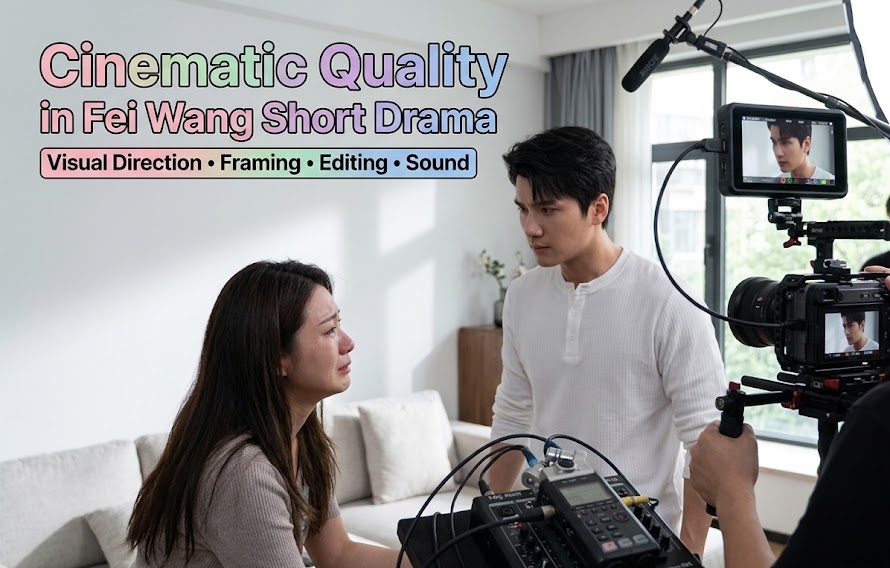
Short dramas have improved considerably in visual presentation, but cinematic quality is not simply a matter of adding shallow depth of field or dramatic music.
The stronger productions use framing, lighting, editing, and actor positioning to make scenes easier to understand. The weaker ones can look expensive while still feeling visually flat.
For a serious series evaluation, several elements deserve attention.
| Element | What To Watch | Why It Matters |
| Framing | Close-ups and character positioning | Controls emotional emphasis |
| Lighting | Consistency between shots | Maintains believable space |
| Editing | Cut timing and reaction shots | Shapes tension |
| Sound | Dialogue, ambience, music | Controls emotional rhythm |
| Blocking | Where actors stand and move | Makes relationships readable |
Camera Framing Should Serve the Performance
A close-up should tell viewers where to look emotionally.
If the camera repeatedly cuts to an actor’s face without giving the performance enough variation, the technique loses its effect. Good directing instead changes shot size according to the emotional importance of the moment.
A wider shot can establish distance between two characters. A medium shot can reveal defensive body language. A close-up can then capture the moment that character finally breaks.
That progression creates cinematic quality without requiring an enormous production budget.
Editing Can Hide Weaknesses but Cannot Solve Everything
Fast editing is often mistaken for energetic storytelling.
Cutting every few seconds may create movement, but it can also prevent an emotional beat from landing. If a character reveals a major secret and the scene immediately jumps to another reaction, the audience may understand the information but fail to feel its impact.
This is especially important in short drama because there is already pressure to keep viewers watching. The editor has to balance speed with comprehension.
Sound Design Is the Quiet Player
Dialogue clarity is more important than an impressive soundtrack.
When music becomes louder than the actors, the emotional manipulation becomes obvious. Natural ambience can sometimes make a scene more believable than another dramatic musical cue.
The best approach is usually selective. Music should intensify a moment rather than instruct viewers how they are supposed to feel during every second.
Pacing Critique Reveals Whether the Story Respects Its Runtime
A short drama does not have to be slow to be sophisticated. It simply needs to understand what information deserves screen time.
The biggest pacing problem in micro-drama is not necessarily speed. It is compression without prioritization.
A story can move rapidly while still feeling repetitive if several scenes deliver the same emotional information. Conversely, a short conversation can feel surprisingly substantial when every line changes the situation.
The First Minutes Have to Establish the Conflict
The opening should answer at least one important question quickly.
Who wants what?
What stands in the way?
Why should the audience care?
The answer does not need to be explained through a giant exposition dump. A visual clue, an awkward exchange, or a character’s immediate decision can establish the central conflict more naturally.
That approach also gives the actor something specific to play.
Plot Twists Need Setup, Not Just Shock Value
Short drama is famous for dramatic reversals: hidden identities, secret marriages, wealthy heirs, betrayals, revenge plans, and sudden revelations.
Those tropes are not automatically bad. They become frustrating when the twist appears without enough preparation.
A useful comparison is how popular short dramas build familiar formulas around recognizable emotional hooks. For example, discussions of Benji Banks emphasize the appeal of established short-drama tropes rather than treating the trope itself as a problem.
That is why the presence of a familiar trope should not be the sole basis for judging a series. The real question is whether the execution adds tension or simply checks another box.
For readers interested in how those recurring formulas work across the format, this guide to the best tropes in Benji Banks short drama provides a useful comparison point.
Cliffhangers Should Change the Story
A cliffhanger works when the next episode becomes necessary.
Ending every episode with a character looking shocked is technically a hook, but it can become predictable. A stronger cliffhanger changes the audience’s understanding of the situation.
For example, discovering that an apparently minor character has been manipulating events is more meaningful than simply delaying an answer for another episode.
Series Evaluation Through Performance, Direction, and Rhythm
A fair series evaluation should separate the actor’s work from the production’s limitations.
If an actor receives repetitive dialogue, rushed blocking, or inconsistent editing, some weaknesses may come from the script or direction rather than performance. Conversely, a talented performer can still struggle if the story gives the character little emotional progression.
That is why the following scoring framework is more useful than a simple like-or-dislike reaction.
| Category | Suggested Weight | Evaluation Focus |
| Facial Acting | 25% | Emotional detail and reaction control |
| Dialogue Delivery | 20% | Natural rhythm and vocal variation |
| Character Chemistry | 20% | Believability in scene interactions |
| Direction | 20% | Framing, blocking, editing and tone |
| Pacing | 15% | Information flow and episode momentum |
Using that framework, the acting should be judged scene by scene rather than based on one dramatic clip.
Facial Acting Is the Biggest Test in Close-Up Scenes
The face has to communicate something even when the character says nothing.
A good actor can let the audience see thought developing before the dialogue arrives. That tiny delay can create anticipation.
The opposite is also true. If an actor waits for the line before changing expression, the scene can feel mechanically synchronized to the script.
Chemistry Requires Listening
Romantic chemistry is often misunderstood as simply looking attractive together.
Real screen chemistry depends on listening and reacting. One actor changes the emotional temperature, and the other responds. Their pauses, eye contact, interruptions, and physical distance create the relationship.
This is particularly important in short dramas because there is little time for a relationship to develop gradually.
Direction Determines How Much Acting Reaches the Audience
Even strong acting can disappear under poor direction.
If reaction shots are cut too quickly, subtle facial work becomes invisible. If the camera stays too far away, physical details may be lost. If every scene uses the same composition, emotional escalation becomes harder to feel.
That makes directing a crucial part of judging the final product.
What Viewers Should Expect From the Short Drama Format
The short-drama market is now broad enough to include romance, historical fantasy, suspense, revenge, family conflict, business stories, and other genres. Current catalogs show just how wide that range has become, with dedicated classifications for everything from romance and historical stories to crime, thriller, medical, and fantasy productions.
The format also continues to favor compact episode structures. One current 2026 iQIYI micro-drama listing, for example, describes a completed 78-episode series with episodes running around three minutes each.
That context changes how acting and pacing should be evaluated.
A performer does not need to deliver the same kind of performance expected in a two-hour feature film. The objective is different. The actor must establish character quickly, maintain clarity, and make small emotional changes readable on a phone screen.
For Fei Wang, the most useful question is therefore not whether the performance resembles a conventional television drama. It is whether the acting makes the compressed storytelling feel human rather than mechanical.
That distinction separates a watchable micro-drama from one that feels assembled entirely around algorithm-friendly cliffhangers.
Final Verdict On Acting Quality and Plot Pacing
The strongest way to approach this title is with realistic expectations. Short drama operates under severe time constraints, and that naturally affects dialogue, character development, editing, and plot structure.
From a theatrical critique perspective, three things matter most: facial control, believable delivery, and purposeful pacing.
If the performer can communicate emotional shifts without relying on exaggerated expressions, the production immediately gains credibility. If the direction allows those reactions enough screen time to register, the result becomes more cinematic. And if every twist actually changes the story rather than merely postponing information, the pacing starts working with the format instead of fighting it.
The available public data is not strong enough to responsibly assign a definitive acting score or claim specific credits for a particular Fei Wang production. That is better than manufacturing details simply to make a recap sound complete. The name itself appears across unrelated film and production records, which makes precise identification essential before making stronger claims.
For viewers deciding whether to invest time in a short drama, the practical takeaway is simple: watch the first few episodes for performance consistency, not just the plot twist. If the actors react naturally, the camera supports those reactions, and each episode meaningfully moves the conflict forward, the series has cleared the three biggest hurdles of the format.
Q&A
Is Fei Wang a well-documented short-drama actor?
Not conclusively from the publicly indexed sources available at the time of this review. Several people with the name Fei Wang or similar names appear in different film records, so attaching unrelated credits to one performer would be unreliable.
What makes acting convincing in a short drama?
The biggest factors are controlled facial reactions, natural dialogue delivery, believable listening, and physical behavior that matches the character’s emotional state. Short episodes make these details particularly visible because there is little time for gradual development.
Why does pacing matter so much in micro-drama?
Because episodes are often extremely short. A current iQIYI example runs for 78 episodes at roughly three minutes per episode, showing how much story can be compressed into a very small runtime.


Leave a Reply