DramaBox Premium Review Evaluating the ROI of Binge Watching
Subscription apps have a clever financial advantage. They do not need every user to watch constantly. They only need enough people to forget that the charge renews. That makes a dramabox premium review worth approaching like a financial audit rather than a simple “is the app good?” question. If someone watches three short dramas every week, the real issue is whether unlimited access costs less than repeatedly buying coins one episode at a time.
DramaBox uses both premium subscriptions and coins, while free viewing and ad-based unlocking can also reduce what a viewer actually spends. Its current terms state that premium content can be accessed through Coins or an active subscription, and subscription pricing can vary by region and offer.
For Indonesian viewers, current marketplace listings provide a useful benchmark. UniPin currently shows a Weekly Membership around Rp114,030 and a Yearly Membership around Rp919,160, alongside coin packages.
So let’s do the math.
DramaBox Premium Cost Compared With Buying Coins
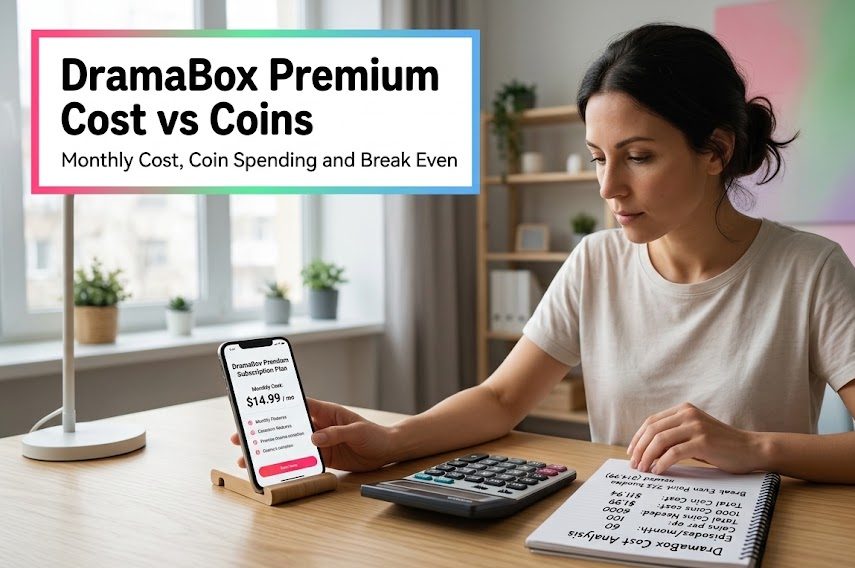
The first question is simple. What happens when a regular viewer pays for individual episodes instead of a membership?
A current third-party pricing tracker, updated in July 2026, estimates that many DramaBox titles cost roughly $13 to complete after the initial free episodes. Its tracked catalog includes dozens of dramas in the 50-to-100-episode range.
That creates a surprisingly important difference between occasional and heavy viewers.
| Viewing Pattern | Approx. Shows Per Month | Estimated Individual Unlock Cost | Subscription Logic |
| Casual | 1 | ~$13 | Coins may be enough |
| Regular | 4 | ~$52 | Membership becomes attractive |
| Heavy | 8 | ~$104 | Subscription has a major advantage |
| Extreme | 12 | ~$156 | Subscription is usually the obvious choice |
These are comparison figures, not a guaranteed checkout total. Coin requirements and offers can change by title, region, platform, and promotion. DramaBox’s terms specifically state that coin prices may vary according to region, payment method, and promotional offers.
One Drama A Month Changes The Equation
If someone finishes only one drama every month, buying coins can make financial sense.
Suppose a complete drama costs approximately $13 through individual unlocking. Paying a monthly subscription simply to finish one title could be unnecessary, especially if much of the catalog remains untouched.
The subscription becomes interesting when the viewer stops being an occasional customer.
Three Dramas A Week Is A Completely Different Calculation
Now consider the scenario this review is really testing.
Three dramas per week equals approximately:
3 × 4 = 12 dramas per month.
If each title costs around $13 to unlock individually, the theoretical monthly spend becomes:
12 × $13 = $156.
That is obviously a rough model, but it illustrates the point. A heavy binge watcher can move from “coins are convenient” to “coins are expensive” very quickly.
At that viewing level, an unlimited-style membership can have a much stronger return.
The Yearly Plan Needs More Scrutiny
A yearly membership may look dramatically cheaper per month, but annual pricing only makes sense when the viewer actually remains active.
Using the current Indonesian UniPin listing of Rp919,160 for a yearly membership, the simple monthly equivalent is approximately:
Rp919,160 ÷ 12 = Rp76,597 per month.
That looks attractive compared with the listed weekly membership of approximately Rp114,030.
But there is a catch.
A yearly plan turns a viewing habit into a commitment. If someone watches intensely for two months and then loses interest, the theoretical monthly saving becomes irrelevant.
Streaming App Subscription Value Depends On Viewing Frequency
The economics become clearer when you treat DramaBox like any other streaming app subscription.
Netflix, Spotify, Disney+, and other subscription services work because frequent usage spreads the cost across many hours. DramaBox has a similar logic, but short episodes make the calculation more unusual.
A viewer might technically watch dozens of episodes while spending only a few minutes per session.
That can make the subscription feel cheaper than it actually is in terms of time consumed.
Three Dramas Per Week Is The Break Even Scenario To Watch
For a person watching three dramas per week, the membership proposition becomes compelling.
Assume one drama takes about 60 episodes and the average episode lasts around one to two minutes. Finishing three dramas weekly could mean approximately 180 episodes per week.
Over four weeks, that is around:
- 720 episodes per month
- Roughly 12 completed dramas
- Potentially 12 separate coin-based purchases
- Continuous access becomes significantly more convenient
DramaBox users have also reported that episodes can be extremely short and that coin consumption becomes frustrating when binge watching. On Apple’s App Store, one reviewer specifically complained about 50-coin episode unlocks and preferred a subscription approach.
That does not prove every viewer will have the same experience, but it highlights the core economic problem.
Occasional Viewers Should Not Pay For An Imaginary Habit
The opposite applies to casual viewers.
If someone watches one drama every two months, an annual membership is difficult to justify.
This is where the “subscription fatigue” problem appears. A cheap monthly payment can feel harmless, but twelve months of automatic renewals can quietly become a much larger expense.
DramaBox’s current terms say subscriptions automatically renew unless canceled before the renewal date.
That makes cancellation discipline part of the financial calculation.
Free Coins Can Change The Calculation
DramaBox does provide alternatives to simply paying.
The app has offered free coins through activities and advertising, while users can also unlock some content without immediately purchasing a membership. The developer has specifically told App Store reviewers that viewers can collect free coins through tasks or advertisements.
That means the true cost for a patient viewer can be substantially lower than the sticker price.
The trade-off is time.
You are effectively paying with attention instead of money.
Platform Catalogue Quality Determines Whether Premium Feels Worth It
Price is only half the story. The other half is platform catalogue quality.
An unlimited subscription is useless if the catalog contains very little that you actually want to watch.
DramaBox’s current service describes thousands of mini-drama episodes across genres such as romance, revenge, rebirth, CEO stories, thriller, and fantasy.
That genre variety is one of the platform’s strongest arguments.
| Viewer Type | Catalog Fit | Subscription Value |
| Romance addict | Very strong | High |
| Revenge fan | Strong | High |
| CEO/billionaire drama fan | Strong | High |
| Fantasy viewer | Strong | High |
| Slow-burn prestige drama fan | Mixed | Lower |
| Occasional viewer | Depends on title | Low |
The platform is built around speed and emotional hooks. It is not trying to compete with conventional television on episode length.
Romance And Revenge Carry A Lot Of The Catalog
If your idea of a good evening is a secret billionaire, fake marriage, revenge plot, hidden heir, or dramatic divorce, DramaBox has a strong proposition.
The platform’s catalog categories are clearly aligned with these popular formulas.
That also explains why one viewer might find the catalog addictive while another thinks it is repetitive.
Short Episodes Make The Catalog Feel Larger
A catalog with thousands of short episodes sounds enormous.
But episode count can be misleading.
If one conventional TV episode runs 45 minutes and a short-drama episode lasts around one or two minutes, comparing “episodes available” directly is meaningless.
The better question is:
How many hours of content do I actually want to watch?
That is the more honest measure of catalogue quality.
Exclusive Titles Need A Separate Test
Exclusive content can justify a membership if it is genuinely the reason you joined.
But “exclusive” does not automatically mean “good.”
An exclusive series review should ask whether the title has strong writing, memorable performances, consistent pacing, and a satisfying payoff.
If the only reason to subscribe is that a cliffhanger is locked behind the paywall, that is a weak value proposition.
Microtransaction Worth Changes When You Binge
The biggest financial trap is not necessarily the membership.
It is the psychology of microtransactions.
Coins feel smaller than real money because the purchase happens in an abstract currency. You see “50 coins” instead of “this episode is costing me part of my monthly entertainment budget.”
That makes microtransaction worth harder to judge emotionally.
DramaBox’s terms confirm that Coins are virtual currency used to unlock premium episodes and that prices can change.
A good rule is to convert every coin purchase back into local currency before deciding.
Calculate The Cost Of A Completed Story
Do not ask:
“Can I afford this episode?”
Ask:
“How much will it cost me to finish this entire story?”
That distinction is huge.
A 50-episode drama may seem affordable when the first few locked episodes cost very little. But multiplying the unlock requirement across the complete series can produce a completely different number.
Compare Coins Against Membership Before Your Second Drama
If you finish one drama using coins, stop and calculate the total.
Then ask what would happen if you watched another three or four titles.
That is the point where subscription pricing becomes easier to understand.
A viewer who watches five or six completed stories in a billing cycle has a completely different ROI from someone who watches half a series and disappears.
Exclusive Series Review Should Include The Actual Viewing Experience
Financial ROI is not only about money.
Time is also a resource.
If a drama forces you through repetitive misunderstandings for 30 episodes before delivering a resolution, an unlimited membership does not make that experience free.
You have still paid with your time.
This is why a good premium audit should combine cost with:
- Story progression
- Episode length
- Cliffhanger quality
- Acting
- Production quality
- Genre fit
- Ending satisfaction
- Catalog depth
One useful example is how short dramas such as Billionaire Buys My Milk short drama use an instantly recognizable hook to pull viewers into a much longer episode sequence. The interesting question is not whether the premise sounds outrageous. It is whether the story keeps earning the next episode.
That is the same standard DramaBox Premium should face.
The Final ROI Verdict For Heavy Binge Watchers
Here is the blunt conclusion.
If you watch three dramas every week, buying coins individually is difficult to defend financially. The sheer number of episodes creates too many opportunities for small purchases to snowball.
If you watch one drama a month, the opposite is true. A subscription can become an unnecessary recurring expense.
The sweet spot is the regular binge watcher who actually uses the catalog.
| User | Recommended Approach | ROI |
| 1 drama every 1–2 months | Coins/free unlocks | Low subscription value |
| 1 drama per month | Compare both | Moderate |
| 1 drama per week | Membership worth considering | High |
| 3 dramas per week | Membership | Very high |
| Daily heavy viewer | Annual plan if available and affordable | Potentially highest |
For an Indonesian viewer, the current listed annual membership of Rp919,160 works out to about Rp76,600 per month if used for the entire year. That is the number to compare against actual monthly coin spending, not the headline annual price.
There is also a practical reason to favor membership for heavy viewers. DramaBox’s developer has explicitly recommended subscription access for users who want broad access rather than repeatedly purchasing individual episodes.
So the verdict is not “Premium is always worth it.”
It is much more specific.
Premium is financially sensible when your viewing habit is heavy enough to consume the catalog regularly. For casual users, free episodes, ads, and carefully chosen coin purchases can be better. For someone watching three dramas every week, the math changes dramatically.
The best move is to track one month of actual spending first. If your coin purchases are already approaching or exceeding the membership price, the subscription is no longer an impulse buy. It becomes the cheaper way to support a habit you already have.
And that is the real ROI test.
Q&A
Does DramaBox Premium unlock every premium drama?
DramaBox’s current terms say active subscriptions can provide access to premium content, while the exact subscription benefits and pricing are displayed at purchase. Content availability can also vary by region.
Is buying coins better than subscribing for casual viewers?
Usually, it can be. If you only finish one title occasionally, paying for the episodes you actually watch may be more economical than maintaining a recurring subscription. Free coins and ad-based options can reduce the cost further.
What is the biggest mistake when paying for DramaBox?
Ignoring the total cost of finishing a series. Short episodes make individual purchases feel inexpensive, but dozens of small unlocks can add up quickly. Calculate the expected cost of completing the whole drama before spending.




Leave a Reply