Why Short Drama Production Quality Is Getting Better Rapidly?
A few years ago, vertical videos were often associated with shaky phone footage, blown-out highlights, muddy audio, and quick edits made for TikTok. Now that same 9:16 frame is carrying scripted stories with dedicated crews, controlled lighting, professional lenses, designed sets, and increasingly polished post-production. The rise of short drama production quality is one of the clearest signs that vertical video has moved from casual social content into a serious entertainment business.
That shift is not happening because audiences suddenly stopped liking fast stories. It is happening because the business around them became much bigger. China’s micro-drama market grew into a multibillion-dollar industry, while international short-drama apps also started generating hundreds of millions of dollars. Deloitte reported that global revenue from micro-drama apps jumped from about $178 million in Q1 2024 to nearly $700 million in Q1 2025.
The interesting part is what happens behind the numbers. Once there is real money in a format, production teams have more reason to improve the thing viewers actually see.
From Blurry TikTok Clips to a Serious Micro Drama Industry
The early appeal of vertical storytelling was its accessibility. Anyone with a smartphone could shoot, edit, upload, and potentially reach millions of people. That low barrier helped establish the viewing habit, but it also created a visual reputation that was not exactly cinematic.
Modern short drama is a different proposition.
The format has become much closer to compressed television than ordinary social video. Episodes commonly run for roughly one to three minutes, while a complete story can stretch across dozens of episodes. The result is a strange but effective combination: television-style storytelling squeezed into mobile-first consumption.
Current industry estimates vary because companies and research firms define the market differently, but the direction is difficult to ignore. TheWrap reported in 2025 that the global vertical short-drama market had already passed $8 billion, while other industry estimates placed the broader micro-drama market even higher.
| Production Era | Typical Approach | Main Visual Priority |
| Early social video | Small creator or amateur crew | Speed and authenticity |
| Early vertical drama | Lean commercial crew | Story volume and fast delivery |
| Current professional model | Specialized production teams | Story, retention and visual consistency |
| Emerging premium model | Film and TV professionals | Cinematography, sound and production design |
The biggest change is therefore not simply that cameras became better. The production mindset changed.
Why professional crews are moving into vertical drama
Short dramas now offer work for directors, cinematographers, editors, actors, production designers, lighting crews and other specialists who understand conventional screen production.
That matters because a professional cinematographer does not simply point a good camera at an actor. They think about exposure, depth, movement, lens choice, skin tones, blocking and how every shot will connect with the next one.
Those decisions become even more important on a phone screen.
A viewer might forgive a slightly awkward line of dialogue. They are less likely to tolerate a face hidden in darkness, unreadable subtitles, clipped audio or a composition that feels accidentally cropped.
Deloitte also notes that audiences are increasingly interested in independently created narrative short-form content, while creators are building independent studios around the format.
That is a major step away from the old “just shoot it vertically” mentality.
Vertical Filmmaking Is Changing How Scenes Are Designed
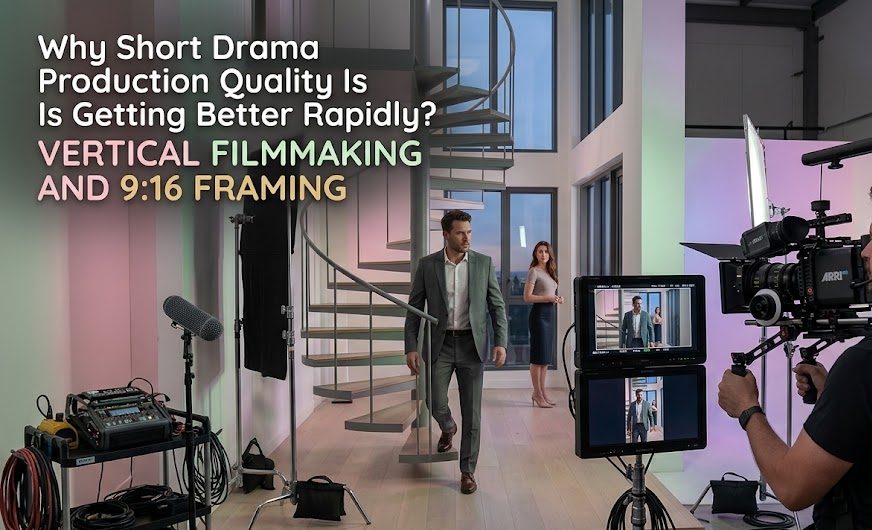
The biggest technical misunderstanding about 9:16 video is that it is simply horizontal filmmaking rotated 90 degrees.
It is not.
Vertical filmmaking changes how characters occupy the frame, how backgrounds are used and even how actors are positioned relative to one another. A production studio working specifically for portrait screens can design blocking around the tall frame instead of treating it as an afterthought.
One professional production guide describes techniques such as placing actors along the Z-axis, allowing foreground and background characters to remain visible without wasting the narrow horizontal space. It also highlights vertical camera movements such as tilts and tracking shots as part of the format’s visual language.
The face becomes the visual anchor
In a traditional widescreen scene, there is plenty of room for a character, another character, furniture, scenery and environmental details.
In 9:16, every inch matters.
That is why close-ups and medium shots are so effective in short dramas. The viewer can immediately read an expression, a reaction or a small physical gesture without needing a huge screen.
This also explains why emotional confrontation works so well in the format. A shocked face, a wedding ring, a phone notification or a threatening glance can occupy a significant portion of the screen.
Blocking has become more deliberate
Imagine two people arguing.
In a conventional widescreen setup, they might stand several feet apart and face each other across the frame. In vertical video, that composition can waste space or push one person partially outside the image.
A better solution may be to place one actor closer to camera and another deeper into the background. The depth of the scene becomes part of the composition.
That sounds like a small technical adjustment, but it changes the entire visual grammar.
Camera movement has a different job
Horizontal pans are not always useful when the frame is narrow. Vertical dramas can instead use push-ins, tilts, tracking movements and carefully controlled handheld shots.
The goal is not to make every scene flashy.
The strongest productions understand that movement should support the emotional beat. A slow push toward a character discovering a betrayal can create tension. A sudden camera move during a confrontation can make the moment feel more urgent.
That is vertical filmmaking functioning as a creative language rather than merely a delivery format.
The Cinematic Upgrade Is Happening Without Hollywood Budgets
Better-looking short dramas do not necessarily mean massive budgets.
This is one of the most important points in understanding the industry. Vertical drama still operates under cost pressure. Productions often use limited locations, compact crews, repeatable sets and accelerated shooting schedules.
A 2025 ContentAsia report described a growing race among production facilities to accommodate lean budgets, compact sets and faster schedules while still improving quality.
That creates a different definition of premium.
Instead of spending millions on one scene, producers may spend strategically on the elements that appear repeatedly across dozens of episodes.
Lighting can deliver a huge visual return
Good lighting is often more important than buying the most expensive camera.
A controlled key light can separate a face from the background. Practical lights can add depth. Better exposure control can prevent windows from turning completely white while keeping actors visible.
For mobile viewing, these improvements are especially noticeable because the viewer is often holding the screen close to their face.
Sound is no longer an afterthought
Poor audio can instantly make an expensive-looking image feel amateur.
Short dramas increasingly benefit from dedicated microphones, cleaner dialogue recording, sound effects and more deliberate mixing. The improvements are subtle when they work, which is exactly the point.
Viewers should concentrate on the story rather than wondering why every conversation sounds like it was recorded inside a bathroom.
Production design has become smarter
A professional-looking location does not always require a huge set.
A well-dressed office, bedroom, restaurant or mansion interior can appear repeatedly, allowing the production team to spread the cost across many episodes.
This is where cinematic upgrade becomes more about consistency than extravagance. A production can feel polished because its colors, lighting, props and locations belong to the same visual world.
The camera does not need to prove that the production spent a fortune. It only needs to make the story feel intentional.
Budget Allocation Matters More When One Shoot Creates Dozens of Episodes
The economics of vertical drama reward efficiency.
A traditional television production might spend heavily on a small number of long episodes. A short-drama production may shoot dozens of compact chapters during a tightly scheduled production period.
That changes budget allocation from a simple question of “How much can we spend?” to “Where will spending be visible across the entire series?”
A production team might prioritize:
- Cast members who can carry emotional scenes
- Locations that can appear across multiple episodes
- Lighting equipment that improves every setup
- Reliable sound recording
- Efficient camera packages
- Post-production that keeps pacing sharp
- Props and costumes that strengthen character identity
- Editing workflows built for rapid delivery
The financial logic is clear. If one location appears in 20 episodes, improving that location can affect a large portion of the final product.
Why lean production can still look expensive
Short dramas often use a limited number of locations because moving a large crew costs time and money.
That limitation can actually help visual consistency.
A carefully designed room can become a recurring visual setting. Different camera angles, lighting changes and blocking can make the same space feel different enough for several scenes.
The trick is knowing where not to spend.
There is little value in an elaborate background if the main character is badly lit or the dialogue is difficult to hear.
Fast schedules are forcing better preparation
Speed does not automatically mean careless filmmaking.
In a professional vertical production, poor preparation can become extremely expensive because a mistake can affect multiple connected episodes. Scripts, shot lists, wardrobe continuity and location planning therefore become important.
The result is a production system that may look fast from the outside but relies heavily on preparation behind the scenes.
That is one reason the visual quality is improving even when budgets remain far below those of major feature films.
Short Drama Production Quality Is Becoming Part of the Competitive Edge
Once audiences become accustomed to better visuals, production quality itself starts influencing whether a series feels worth watching.
Story remains the main attraction, especially because short dramas depend heavily on romance, revenge, family conflict, power struggles and cliffhangers. But visual execution determines how easily the audience enters that story.
The market is already attracting established entertainment companies. TheWrap reported that Fox Entertainment invested in a major vertical-drama player, while Telemundo Studios began producing adaptations. SAG-AFTRA and WGA have also developed vertical agreements, showing that the format is increasingly being treated as legitimate professional production rather than an internet side project.
That professionalization has consequences.
Actors have to perform for a smaller frame
In vertical drama, the camera is frequently close to the actor.
That means tiny changes in expression become important. An actor does not always need a large physical performance because the viewer can see the face clearly.
It also puts pressure on casting. A performer who can communicate emotion quickly becomes extremely valuable when an episode has only a minute or two to establish conflict.
Editors are balancing story and retention
A polished image cannot rescue a boring episode.
Editors therefore have two jobs: maintain visual continuity and keep the narrative moving. Dialogue may be tightened, reaction shots placed strategically and scenes cut at moments designed to encourage viewers to continue.
The famous cliffhanger is not simply a writing trick. It is part of the entire production structure.
A close-up, music cue, reaction and cut to black can all work together to create the “one more episode” effect.
What Comes Next for Vertical Drama
The biggest change may be that audiences will stop thinking about vertical drama as a separate novelty.
The format is already spreading internationally. Deloitte found that micro-drama apps have become significant players in the U.S. entertainment market, while short-form narrative content is attracting creators and independent studios.
At the same time, the industry is still figuring out what premium vertical storytelling should look like.
Some productions will continue to prioritize speed, sensational plots and low production costs. Others will push toward stronger cinematography, more sophisticated acting and genre variety.
The two models can coexist.
The most successful producers will probably be those that understand the phone screen rather than trying to imitate television on a smaller display. That means designing shots for portrait viewing, keeping dialogue readable, using locations efficiently and spending money where the audience can actually see the difference.
For viewers who follow individual series, this shift is already noticeable. Even a familiar revenge or billionaire romance plot can feel considerably more immersive when the lighting, sound, performances and framing work together.
The cinematic upgrade is therefore not just about making short dramas prettier. It is about proving that a story designed for a phone can still have a genuine visual identity.
What Better Production Quality Actually Means for Viewers
The next stage of the format is unlikely to be defined simply by bigger cameras or more expensive sets.
Instead, quality will probably be judged by consistency.
A strong vertical series should make its characters easy to read, its dialogue easy to hear and its visual world easy to recognize. It should use the 9:16 frame deliberately rather than treating portrait orientation as a technical requirement.
For producers, that means smarter budget allocation. For filmmakers, it means learning a different visual grammar. For audiences, it means short dramas can increasingly look like intentional screen productions rather than extended social-media clips.
That is the real reason the format is improving so quickly. There is now enough money, competition and professional interest to reward people who can make mobile-first storytelling look genuinely good.
And when a genre can combine fast production with increasingly sophisticated filmmaking, its ceiling becomes much higher than the early TikTok clips ever suggested.
Q&A
1. Why does vertical drama look more cinematic now even when budgets remain relatively small?
Because production teams are becoming more specialized. Better lighting, sound recording, blocking, lenses, production design and editing can create a major visual improvement without requiring a feature-film budget.
2. Is 9:16 actually limiting filmmakers creatively?
It can be limiting if filmmakers simply crop horizontal footage. When scenes are designed for portrait viewing from the start, however, the narrow frame can encourage stronger close-ups, layered blocking and more focused visual storytelling.
3. Will professional film studios replace the low-budget short-drama model?
Probably not completely. The format’s strength comes partly from its speed and relatively low production costs. Professional studios are more likely to add new production standards, talent and financing models while the lean model continues operating alongside them.



Leave a Reply