My Dearest Boss Short Drama Binge Review Pacing and Chemistry
Boss-employee romances can get toxic fast. The boss controls the workplace, the employee risks her job, and fiction sometimes treats intimidation, manipulation, and power imbalance as if they were automatically romantic. That makes my dearest boss short drama worth judging on a different scale. Does the story actually build affection between two people, or does it simply turn workplace tension into a shortcut for chemistry?
The 2022 Chinese mini-drama My Dearest Boss takes a lighter route. The official WeTV listing describes a 30-episode romance about Yu Xingchui and her boss Liu Yu’an, with episodes presented in a short-form format. The central gimmick is that Xingchui unexpectedly inherits a valuable property and accidentally becomes Liu Yu’an’s neighbor, creating conflict both at work and at home.
That setup is important because the romance does not depend entirely on office attraction. The two characters have another arena where their relationship can develop, argue, and eventually soften. The result is a breezy short drama with a surprisingly useful question at its center: can a boss-employee romance feel playful rather than uncomfortable?
My Dearest Boss Short Drama Sets Up A Workplace Romance Outside The Office
Yu Xingchui is introduced as a hardworking office worker whose fortunes suddenly change after she inherits a valuable house. The twist is almost immediately complicated when she discovers that her new neighbor is none other than her boss, Liu Yu’an. WeTV’s synopsis confirms that their relationship begins with clashes at work and in their neighborhood before gradually developing into affection.
That is a smart structure for a six-minute-per-episode story.
Instead of forcing every romantic development into office meetings, the drama can move between professional and personal situations.
Yu Xingchui Is The Emotional Entry Point
Yu Xingchui works because she is not introduced as someone deliberately chasing her boss.
She is primarily trying to deal with her own changing circumstances. The inheritance gives her a new home and financial security, but it also accidentally puts her in Liu Yu’an’s personal orbit.
Her personality is generally more upbeat than his, which creates the basic contrast the romance needs.
She reacts.
He stays controlled.
She gets annoyed.
He becomes increasingly interested.
That contrast gives the early scenes their comic energy.
Liu Yu’an Starts As The Typical Cold Boss
Liu Yu’an is built from familiar CEO-romance ingredients.
He is strict, reserved, organized, and difficult to read. CPOP HOME identifies the series as a modern romance with a boss-employee relationship and lists Guo Jianan as Liu Yu’an and Gong Fangni as Yu Xingchui.
The important difference is that the story does not keep him completely confined to the office.
Once Xingchui becomes his neighbor, his authority over her becomes less useful.
That forces their relationship onto more equal ground.
The Mansion Twist Makes The Romance Less Predictable
The inheritance is not just a convenient excuse to make Xingchui wealthy.
It changes the power dynamic.
She is no longer simply an employee struggling to survive around a demanding boss. She has her own property, her own space, and a life outside the company.
That makes their eventual attraction easier to accept.
Yang Xu Adds The Missing Piece Of Liu Yu’an’s Past
The romance eventually connects to Liu Yu’an’s unresolved guilt.
Yang Xu, his mother, returns after years away and reveals information about a tragedy involving Xingchui’s father and Liu Yu’an. WeTV’s official synopsis explains that the revelation helps Xingchui understand Liu Yu’an’s emotional burden and ultimately helps him move beyond his self-blame.
This prevents the story from being only about flirting.
There is an emotional wound underneath the comedy.
Workplace Romance Review Finds Chemistry In The Bickering
A good workplace romance review should not automatically reward a pairing simply because the leads look attractive together.
Chemistry comes from interaction.
In My Dearest Boss, much of that interaction starts with irritation. Xingchui and Liu Yu’an are constantly placed in situations where their personalities collide.
That is familiar rom-com territory, but the short format makes timing especially important.
Their Arguments Do More Work Than The Romantic Scenes
The early quarrels establish the relationship better than an immediate love confession would.
Xingchui does not treat Liu Yu’an like a mysterious fantasy man. She gets annoyed with him.
Liu Yu’an, meanwhile, cannot simply rely on his position as her boss once they are standing on opposite sides of a neighborhood dispute.
Those moments create a more natural rhythm.
The attraction becomes something that grows underneath the arguments rather than appearing from nowhere.
Guo Jianan Plays Liu Yu’an With Controlled Energy
Liu Yu’an needs restraint.
If he becomes too expressive too early, the cold-boss persona disappears. If he stays completely emotionless, there is nothing for Xingchui to react to.
The performance therefore depends on small changes in expression and tone.
A glance that lasts slightly too long can do more for the romance than a dramatic declaration.
Gong Fangni Gives Xingchui A More Playful Counterweight
Gong Fangni’s Xingchui is positioned as the livelier half of the pairing.
That contrast helps prevent the scenes from becoming visually and emotionally flat.
She can push the conversation forward while Liu Yu’an holds back, creating the push-pull dynamic that short romance needs.
This is one reason the series remains watchable despite its limited runtime.
Slow Burn Pacing Is Impossible When Every Episode Lasts Minutes
Here is where the drama becomes more complicated.
A conventional slow burn can spend several episodes showing characters gradually becoming comfortable with each other. My Dearest Boss has only 30 episodes, with CPOP HOME listing each at roughly six minutes. TVmaze likewise records a default runtime of six minutes.
That gives the entire story approximately 180 minutes if every episode is treated as six minutes.
So the series has room for development, but not the kind of slow burn found in a traditional 16-episode television romance.
The First Encounters Move Quickly
The inheritance and neighbor reveal happen early because the story needs its central gimmick immediately.
That is good short-drama storytelling.
There is little value in spending three episodes establishing that Xingchui is an employee and Liu Yu’an is her boss. The audience needs the collision quickly.
The Romance Has To Share Space With The Family Mystery
The later story introduces Liu Yu’an’s emotional history.
This gives the romance additional weight, but it also divides the available runtime.
The audience is now watching:
- Workplace conflicts
- Neighbor conflicts
- Romantic development
- Liu Yu’an’s past
- Yang Xu’s return
- Xingchui’s attempt to help him
That is a lot for a six-minute format.
Plot Jumps Are The Main Pacing Weakness
One independent review makes essentially the same criticism, describing the show as a pleasant short office romance while noting that its short runtime leaves little room for character depth and creates noticeable plot jumps.
That is probably the fairest criticism.
The story gets where it needs to go, but sometimes the emotional transitions feel faster than the characters’ actual development.
Character Dynamic Works Because Their Power Balance Changes
The strongest character dynamic is not simply “cold boss meets cheerful employee.”
It is the gradual reduction of Liu Yu’an’s control over the relationship.
At work, he has authority.
At home, he is simply Xingchui’s neighbor.
That distinction matters.
Liu Yu’an Cannot Hide Behind His Job At Home
Office hierarchy gives Liu Yu’an an obvious advantage.
He can assign tasks.
He can criticize work.
He can maintain professional distance.
But the moment the characters meet outside the company, those tools stop working.
That creates better comedy and better romance.
Xingchui’s Financial Change Makes Her Less Dependent
The inheritance is a classic wish-fulfillment device, but it has a practical narrative function.
Xingchui does not need to impress Liu Yu’an financially.
She has her own house.
That reduces the possibility that the romance will feel like an employee seeking security through her boss.
It does not completely erase the workplace power imbalance, but it softens it significantly.
Their Neighbor Relationship Creates Forced Proximity
Forced proximity is one of the most reliable romance devices because it creates repeated encounters without requiring characters to behave irrationally.
Xingchui and Liu Yu’an can keep running into each other naturally.
They cannot simply avoid each other after an awkward office conversation because they live next door.
That gives the series a steady supply of interactions.
The Final Emotional Conflict Gives Liu Yu’an More Depth
The reveal involving Xingchui’s father changes how viewers understand Liu Yu’an.
His strictness and emotional distance are connected to guilt rather than simply arrogance.
Xingchui’s role also changes.
She is no longer just the woman who keeps arguing with her boss.
She becomes someone who understands the emotional source of his behavior and helps him confront it.
Series Critique Finds A Sweet Romance With Limited Depth
The overall series critique comes down to one trade-off.
My Dearest Boss is easy to binge because it does not overstay its welcome, but that same brevity limits how deeply it can explore its characters.
The available episode information varies slightly across databases. WeTV currently lists 30 episodes, while some older review sources describe a 24-episode mini version. The more current WeTV listing is the stronger reference for the present episode count.
That discrepancy is worth noting because short dramas are frequently redistributed or repackaged into different episode cuts.
| Category | Verdict |
| Romance Setup | 8/10 |
| Lead Chemistry | 8/10 |
| Comedy | 7.5/10 |
| Pacing | 7/10 |
| Character Depth | 6.5/10 |
| Emotional Payoff | 7.5/10 |
| Workplace Realism | 6.5/10 |
| Overall | 7.3/10 |
The strongest reason to watch is not realism.
This is still a fantasy version of workplace romance, complete with an unexpected inheritance and an unusually convenient mansion situation.
The appeal is the combination of light comedy and emotional repair.
Is The Boss Romance Actually Healthy?
This is where the show deserves a more nuanced verdict.
A boss dating an employee naturally creates a power imbalance. In real life, that can create problems involving promotions, workplace pressure, favoritism, and consent.
The drama does not spend much time examining those practical consequences.
Instead, it uses the boss-employee relationship primarily as a source of romantic friction.
That means viewers should separate fantasy from workplace advice.
The relationship becomes easier to accept because Xingchui gains financial independence and because their relationship develops outside the office. But the professional hierarchy still exists.
The drama is therefore better described as a light romantic fantasy than a realistic model of healthy workplace relationships.
That distinction matters.
Final Verdict On My Dearest Boss Short Drama
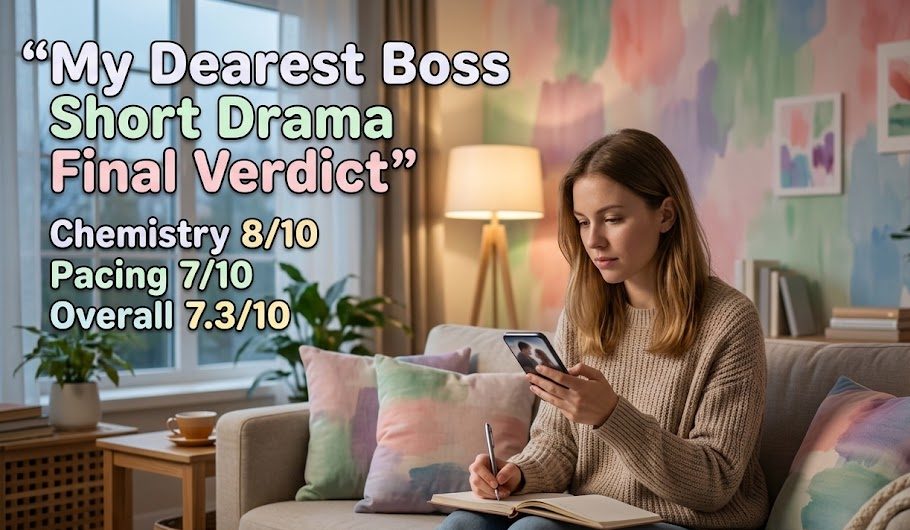
My Dearest Boss understands what its format needs.
It establishes the inheritance twist quickly, puts the leads together in both professional and personal settings, and lets their relationship develop through arguments before introducing a more serious emotional conflict.
The 30-episode structure is compact, with WeTV currently listing the complete series and six-minute episodes.
The biggest strength is chemistry.
Guo Jianan and Gong Fangni have a workable opposites-attract rhythm. Their scenes are more entertaining when they are bickering than when the script simply tells viewers that they are falling in love.
The biggest weakness is depth.
There simply is not enough runtime to fully explore every emotional transition. Some developments happen because the story needs to reach the next beat rather than because the characters have had enough time to process what happened.
Still, for viewers who want a light office romance that can be finished quickly, that is not necessarily a dealbreaker.
The final score lands at 7.3/10.
It is cute rather than profound, brisk rather than genuinely slow burn, and more interested in romantic entertainment than workplace realism.
And that is perfectly fine.
The best way to watch it is not as a lesson in office relationships but as a compact romantic comedy built around a boss, an unexpectedly wealthy employee, a very inconvenient neighboring arrangement, and two people who slowly discover that arguing with each other is becoming much more interesting than avoiding each other.
For viewers who enjoy familiar short-drama formulas, the recurring tropes behind this kind of setup are also worth understanding. This guide to the best tropes in Benji Banks short drama gives useful context for why devices such as forced proximity, status differences, and sudden romantic reversals work so consistently in the format.
Q&A
How many episodes does My Dearest Boss have?
The current WeTV listing shows 30 episodes, with episodes 6 through 30 marked VIP. CPOP HOME also lists 30 episodes at approximately six minutes each. Some older sources describe a 24-episode cut, so viewers may encounter different episode counts depending on the platform or version.
Why does Yu Xingchui become Liu Yu’an’s neighbor?
Yu Xingchui unexpectedly inherits a valuable house. She then accidentally enters the wrong residence and discovers that Liu Yu’an, her boss, is her new neighbor. The unusual living arrangement becomes the main mechanism for developing their relationship outside the workplace.
Does the story explain why Liu Yu’an is emotionally distant?
Yes. The later conflict connects Liu Yu’an’s emotional burden to a tragedy involving Yu Xingchui’s father. Yang Xu reveals the history, and Xingchui eventually helps Liu Yu’an confront his guilt.




Leave a Reply