The Evolution of the Poor Son in Law Trope in Micro Dramas
A wealthy family laughing at a man because he cannot afford their lifestyle creates a particular kind of collective humiliation. The audience is not simply watching one husband get insulted. They are watching every assumption about money, masculinity, marriage, and social status being thrown at him at once. That is exactly where the poor son in law trope gets its power, especially when the supposedly useless husband is eventually revealed to be the person with enough influence to overturn the entire family hierarchy.
The formula is familiar across modern short dramas. A live-in husband is treated like a servant, his wife is pressured to leave him, the in-laws measure his worth through money, and then one reveal changes everything. Recent short-drama catalogs continue to use this structure heavily, with titles built around billionaire husbands, hidden identities, revenge, and counterattacks.
1. Poor Son In Law Trope Turns Humiliation Into A Male Power Fantasy
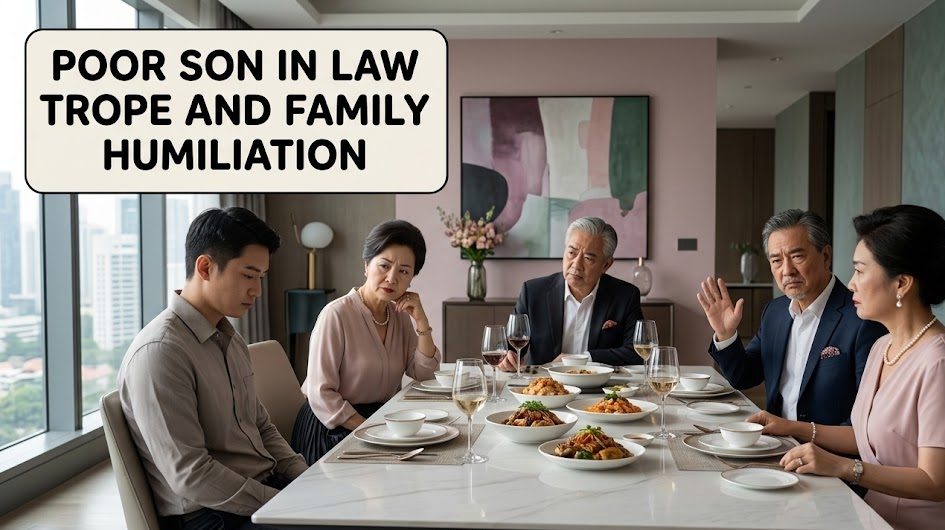
The central fantasy is surprisingly straightforward. The man starts with almost no social power, yet the audience is given enough information to believe that something is being hidden.
He may appear unemployed. He may dress cheaply. He may live in his wife’s family home. He may even be called useless directly to his face.
But the story keeps dropping tiny clues.
- Someone important recognizes him.
- A powerful executive suddenly becomes nervous around him.
- He receives an unexpected phone call.
- His wife discovers that his past does not match his current lifestyle.
- A supposedly ordinary object turns out to be connected to a massive company.
- The family that mocked him eventually needs his help.
That delay is important. The longer the story makes him swallow humiliation, the bigger the eventual reversal feels.
Why The In-Laws Have To Be Especially Cruel
The in-laws are not merely antagonists. They represent the social hierarchy that has rejected the protagonist.
A mother-in-law who complains about his clothes is easy to understand. A brother-in-law who mocks his job creates competition. A wealthy relative who flaunts a luxury car establishes the economic gap in seconds.
The audience does not need a long explanation of class tension. One dinner scene can do it.
The Live-In Husband Becomes The Lowest Person In The Room
The live-in arrangement intensifies the humiliation because the man is physically surrounded by people who consider themselves superior.
He eats at their table but is not treated as an equal. He belongs to the family legally but not emotionally.
That contradiction makes his eventual rise more satisfying.
The Wife Often Controls The Emotional Stakes
The wife is frequently caught between her family’s expectations and her husband’s quiet resilience.
At first, she may believe the insults. Later, she notices inconsistencies. Finally, she becomes one of the people forced to confront how badly her family misjudged him.
That shift is often more important than the billionaire reveal itself.
2. Hidden Billionaire Heir Is The Reveal That Rewrites Every Insult
The hidden billionaire heir formula works because it changes the meaning of previous scenes rather than simply adding money to the story.
Before the reveal, the expensive restaurant is a place where the husband is embarrassed. After the reveal, the same restaurant might belong to his company.
Before the reveal, the family laughs at his cheap phone. Afterwards, a single call from that phone can change a business deal.
That is why identity reveals are so common in short drama. They are extremely efficient storytelling tools.
The Billionaire Son in Law, for example, follows a husband who has endured years of contempt before revealing that he is actually the heir to a massive global empire. The platform explicitly frames the story around humiliation, hidden power, counterattack, and the reversal of the family hierarchy.
The CEO’s Hidden Billionaire Husband uses a similar engine. Su Chen is mocked as a live-in son-in-law while secretly being a billionaire with powerful connections. When his wife’s business faces trouble, his hidden influence becomes impossible to ignore.
The appeal is not really financial realism. It is dramatic justice.
The Reveal Has To Arrive After Maximum Disrespect
If the protagonist reveals his identity after two episodes, there is little emotional investment.
Short dramas usually benefit from delaying the reveal until the audience has watched him endure enough disrespect to make the reversal satisfying.
Wealth Functions Like A Story Shortcut
A billionaire identity immediately answers several questions.
Who has power?
Who controls the company?
Who can afford the impossible?
Who has connections?
Who can destroy the antagonist’s social position?
The story does not have to spend ten episodes building those answers.
A Secret Lineage Makes The Hero Feel Destined
The protagonist is not simply lucky. He was supposedly important all along.
That distinction is central to the fantasy. The audience is encouraged to reinterpret his poverty as temporary concealment rather than genuine weakness.
The Best Reveals Connect To Earlier Clues
A random inheritance can feel cheap. A reveal that explains previous strange behavior feels much better.
The Rule-Breaking Son-in-Law follows this pattern by presenting Rowley as a humiliated live-in husband before revealing his prestigious lineage and enormous inheritance, which launches his counterattack against people who previously looked down on him.
3. Face Slapping The In Laws Becomes The Real Episode Payoff
Once the identity is exposed, the story moves into its most addictive phase. The insults that once made the protagonist powerless become opportunities for face slapping the in laws.
The phrase sounds exaggerated because the storytelling itself is exaggerated. These scenes are designed to deliver instant emotional gratification.
A relative says he cannot afford something.
Then he buys it.
Someone claims he has no connections.
Then the most powerful person in the room greets him.
Someone demands that he leave.
Then the family discovers that the property, company, or contract belongs to him.
The reversal does not need to be subtle. In fact, subtlety can weaken the payoff in a format built around rapid emotional turns.
| Setup | Humiliation | Reversal |
| Cheap clothes | Called useless | Expensive identity revealed |
| No visible job | Accused of freeloading | Secret executive position |
| Low-status husband | Pressured to divorce | Powerful family lineage |
| Mocked by relatives | Public embarrassment | Powerful allies appear |
| Family rejects him | Wife is pressured to leave | Family needs his help |
The current short-drama ecosystem shows how closely this structure is tied to revenge and billionaire storytelling. Recent titles repeatedly combine son-in-law humiliation with counterattack, CEO status, hidden wealth, or an unexpected inheritance.
Why Public Humiliation Works Better Than Private Insults
A public scene creates witnesses.
The audience sees the protagonist being embarrassed in front of everyone, so the later reversal can happen in front of exactly the same people.
That creates a clean emotional equation.
Humiliation in public.
Justice in public.
The person who laughed becomes the person forced to apologize.
Luxury Cars Are More Than Props
Cars are frequently used because viewers understand their social meaning instantly.
A cheap vehicle establishes the character’s supposed position. A luxury car arriving at the right moment can signal that the family’s assumptions are collapsing.
The same principle appears in recent short-drama material where relatives mock a supposedly poor husband before discovering connections to high society.
Business Meetings Create Easy Power Reversals
A boardroom is another efficient stage for the reveal.
The protagonist enters looking ordinary. The executives dismiss him. Then someone recognizes him as the person who actually controls the company.
The entire room changes within seconds.
4. Revenge Fantasy Male Lead Works Because Patience Looks Like Strength
The revenge fantasy male lead is usually not powerful because he shouts the loudest. His strongest characteristic is patience.
He knows something the audience does not.
That creates a particular rhythm. The protagonist absorbs an insult, stays quiet, and lets the antagonist become increasingly confident.
Then the truth arrives.
This is why The Unfavored Son-in-Law follows a fallen heir who lives as a despised husband before his hidden power begins to surface. Its description explicitly frames the character as someone enduring humiliation while waiting for his chance to reclaim his dignity.
The formula is almost theatrical.
- The villain underestimates him.
- The protagonist refuses to explain himself.
- The villain becomes more arrogant.
- The audience learns another piece of the secret.
- The protagonist finally acts.
- The villain discovers the mistake.
That pattern can repeat several times because every new opponent provides another opportunity for reversal.
His Silence Gives The Audience An Advantage
The protagonist often knows more than the other characters.
That makes viewers feel like insiders.
When the mother-in-law says he is worthless, the audience can think, Just wait.
That anticipation becomes part of the entertainment.
Revenge Is Usually More Important Than Romance At The Midpoint
The marriage may have introduced the story, but the middle episodes often become focused on family conflict, business rivalry, betrayal, or social humiliation.
Romance returns once the power imbalance has been corrected.
The Hero Rarely Needs To Beg For Respect
That is part of the fantasy.
He does not convince the family through a long speech. He demonstrates his status through action.
The family changes its behavior because reality forces them to.
His Greatest Victory Is Often Emotional
Money can defeat a business rival, but emotional recognition is what completes the story.
The wife finally understands him.
The parents realize their mistake.
The relatives lose their arrogance.
The protagonist no longer needs their approval.
That is the actual victory underneath the money.
5. Status Reversal Explains Why The Formula Still Works
The entire structure eventually arrives at status reversal. The person who began at the bottom suddenly occupies the top position.
That is why these stories can feel repetitive and still remain bingeable.
The audience is not necessarily watching to discover whether the man will rise. They are watching to discover how badly everyone will regret underestimating him.
Recent releases show just how broad the formula has become. Masked Magnate: The Dominant Son-in-Law gives its mocked husband a powerful CEO identity, while Idiot Son-in-Law uses a fallen genius who is treated as a fool before awakening and reclaiming his position.
The stories change names, companies, wives, villains, and family circumstances, but the emotional architecture remains recognizable.
The Bottom Position Makes The Top Position Feel Bigger
A wealthy protagonist who starts wealthy has nowhere dramatic to climb.
A humiliated husband does.
Every insult becomes another step downward, which makes the eventual rise feel enormous.
The Family Becomes A Symbol Of The Old Hierarchy
The protagonist does not merely defeat one villain.
He proves that the family was wrong about what determines a person’s value.
That is why the final family gathering can feel more important than a business victory.
The Wife’s Reaction Often Determines Whether The Ending Feels Earned
If she immediately becomes affectionate after learning that her husband is rich, the romance can feel transactional.
A stronger story lets her regret how she treated him and recognize that his character existed before his wealth was revealed.
The Final Reversal Works Best When It Changes Relationships
The richest payoff is not simply a bigger bank account.
It is seeing people who once dismissed him suddenly unable to control him.
The man who was told to leave now decides who stays.
The husband who was treated like a burden becomes the person everyone depends on.
That is the emotional core of the poor son in law trope. It turns social humiliation into a fantasy of complete correction. The audience watches a man lose status, endure disrespect, hide his true identity, and eventually reclaim control over the exact people who believed they had power over him.
The formula is undeniably repetitive. But repetition is part of its appeal. Micro dramas are built for fast recognition, fast conflict, and even faster payoff. A viewer can understand the setup within minutes and immediately know what emotional reward the story is promising.
The more interesting evolution is therefore not whether the poor husband becomes rich. That reveal has become almost expected. The real evolution is in what happens after the reveal.
Does he protect his wife?
Does he expose a larger family secret?
Does he reject the people who suddenly want him back?
Does he use his power for revenge or responsibility?
And, most importantly, does his new status actually change who he is?
Those questions give an old formula room to breathe.
Q&A
Why Is The Poor Husband Usually Humiliated By His Wife’s Family?
Because the in-laws provide an immediate social hierarchy. Their contempt establishes the protagonist at the bottom, making the later reversal much easier for viewers to understand and feel.
Why Do Short Dramas Keep Using Billionaire And Hidden-Heir Reveals?
Because wealth and lineage communicate power almost instantly. A single reveal can change business relationships, family dynamics, marriage conflicts, and the protagonist’s social position without requiring a long setup.
Does The Formula Need A Billionaire Reveal To Work?
No. The same structure can use a military identity, powerful family, CEO position, elite skill, inheritance, or forgotten reputation. What matters is the status reversal: the person everyone dismissed turns out to have far more power than they assumed.




Leave a Reply